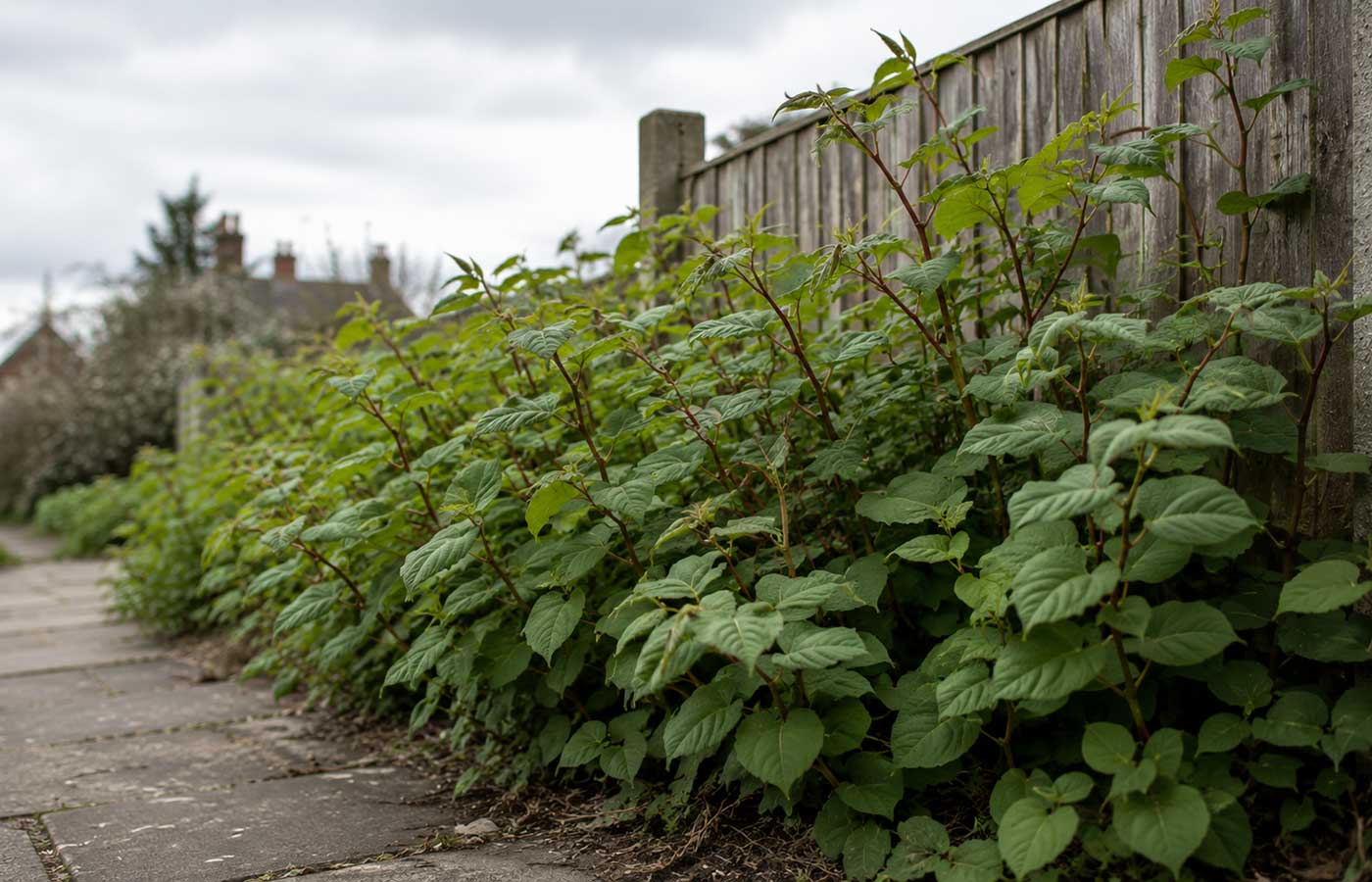
Bindweed and knotweed are frequently confused
Many people searching for Japanese knotweed information eventually discover that the plant in their garden is actually bindweed.
The confusion is understandable because both plants can spread aggressively and appear difficult to control once established.
However, despite the similar names and reputation for rapid growth, bindweed and Japanese knotweed are very different plants once examined more closely.
The overall growth habit is usually very different
One of the clearest differences is the way the plants grow.
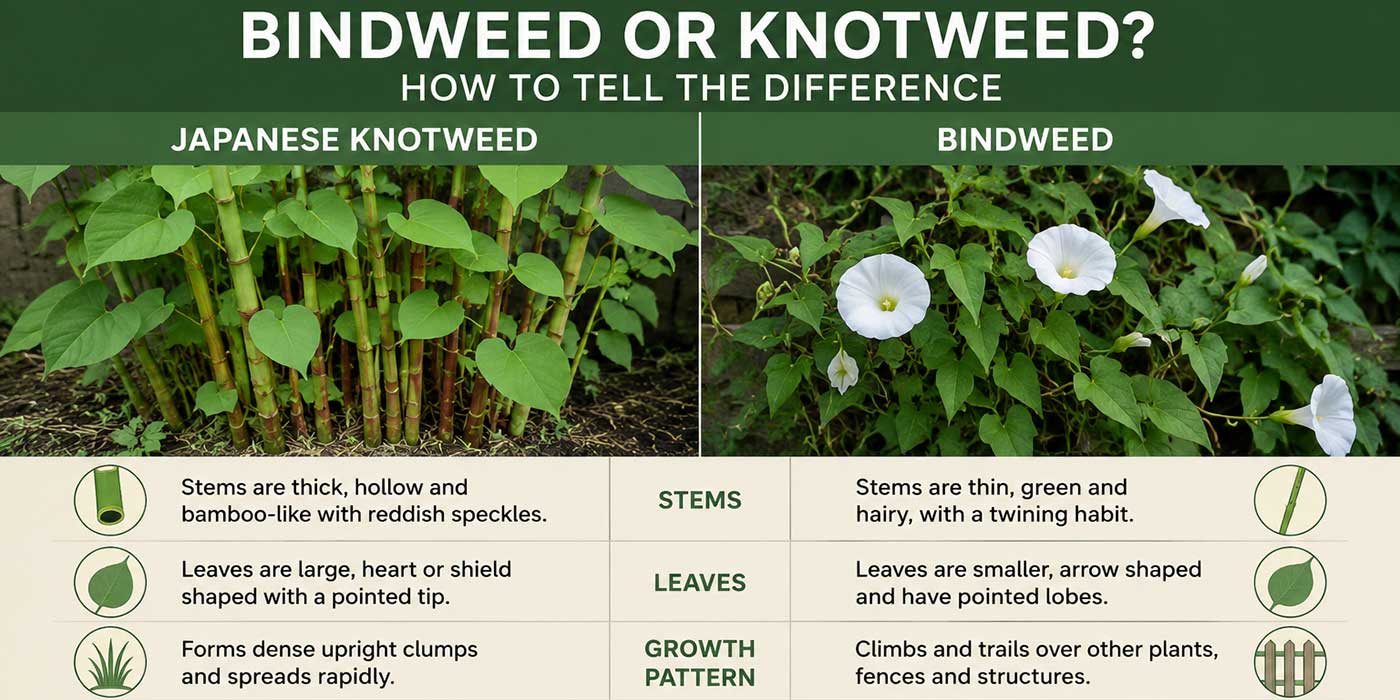
Japanese knotweed normally grows upright in dense clumps with thick cane-like stems.
Bindweed behaves more like a climbing or trailing vine. It commonly wraps itself around fences, shrubs, railings and other plants as it spreads.
If the plant is twisting itself around surrounding structures, bindweed is usually more likely.
Bindweed stems are much thinner
Stem thickness is another useful clue.
Japanese knotweed stems are generally:
- Thick and upright
- Hollow inside
- Segmented like bamboo
- Green with reddish or purple speckling
Bindweed stems are usually:
- Thin and flexible
- Green and string-like
- Twisting or climbing
- Much less rigid
Bindweed rarely forms the strong upright canes associated with mature knotweed growth.
The leaves are shaped differently
Leaf shape often provides one of the easiest ways to distinguish between the two plants.
Japanese knotweed leaves are normally broad with a flat base and pointed tip. Many people describe them as shield shaped or heart shaped.
Bindweed leaves are usually:
- Smaller
- Arrow shaped
- More pointed at the sides
- Attached along climbing stems
Once both plants are viewed side by side, the foliage generally looks quite different.
Bindweed flowers are very different from knotweed flowers
Flowering is another major difference.
Bindweed commonly produces:
- White or pale pink flowers
- Trumpet or funnel shapes
- Flowers similar to miniature morning glory plants
Japanese knotweed flowers are much smaller and usually appear as creamy-white clusters spread across mature stems.
Large trumpet-shaped flowers generally indicate bindweed rather than knotweed.
Knotweed usually forms dense upright patches
Established Japanese knotweed commonly creates thick blocks of upright vegetation during summer.
The growth often:
- Emerges in clusters
- Creates dense leafy areas
- Returns from the same location each year
- Produces bamboo-like canes
Bindweed spreads differently by weaving itself through surrounding plants and structures.
Instead of forming dense upright canes, bindweed tends to spread outward and upward by climbing.
Bindweed often climbs through hedges and fences
One of the easiest visual clues is the climbing habit of bindweed.
It commonly wraps itself around:
- Garden fencing
- Shrubs and hedges
- Railings
- Garden canes
- Other plants
Japanese knotweed usually grows as self-supporting upright stems rather than climbing.
Winter appearance is often very different
During winter, Japanese knotweed usually dies back leaving dry hollow canes above ground.
Bindweed generally leaves behind thinner dead climbing stems rather than thick bamboo-like canes.
The winter structure of the plant often provides useful identification clues once leaves have disappeared.
Both plants can spread aggressively
One reason bindweed is sometimes mistaken for knotweed is that both plants are known for spreading quickly once established.
Bindweed can become difficult to remove because of its extensive root system and climbing growth habit.
Japanese knotweed spreads differently through underground rhizomes that repeatedly produce new shoots.
Although the two plants behave differently, both are often viewed as troublesome garden growth.
Photographs that help identify bindweed and knotweed
If you are trying to compare suspicious growth, it usually helps to photograph:
- The overall growth pattern
- Leaves and stems together
- Flowers if present
- The surrounding area
- Any climbing growth
- The base of the plant
Whole-plant photographs generally provide more useful clues than isolated close-up images.
Many suspected knotweed plants turn out to be bindweed
Bindweed is extremely common in UK gardens and regularly causes concern when it begins spreading rapidly through borders and fences.
In many situations, the plant eventually turns out not to be Japanese knotweed at all.
Looking carefully at stem thickness, leaf shape and whether the plant climbs or stands upright usually provides a much clearer indication.
Related pages
Need help identifying a plant?
You can send photographs for an initial knotweed identification check.