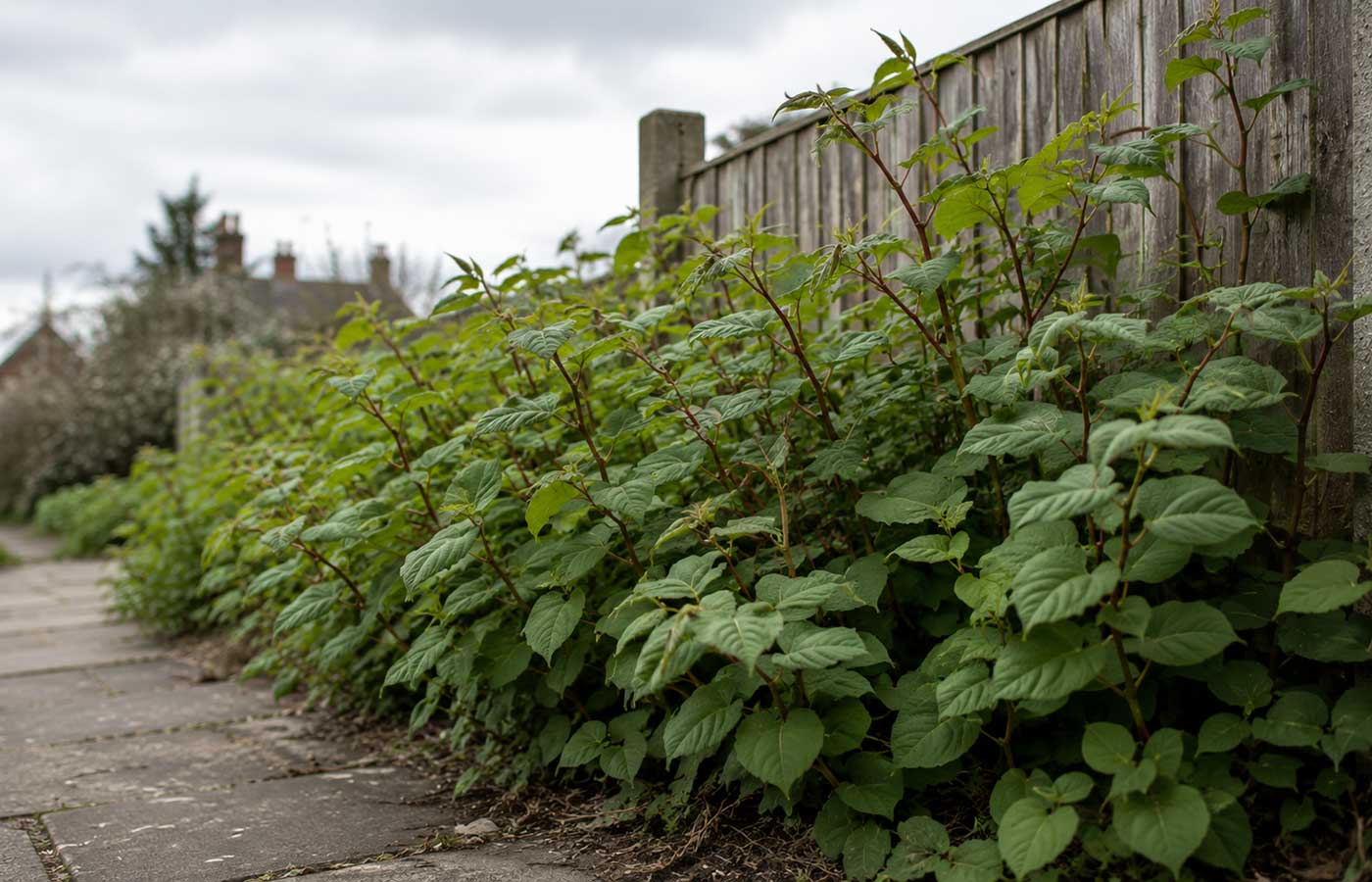
Why red shoots often cause concern
Many people first begin worrying about Japanese knotweed during spring when unusual red shoots start emerging from the ground.
Because knotweed shoots are commonly reddish or purple during early growth, people often search online photographs after spotting similar stems appearing near fences, paving or garden borders.
The problem is that several ordinary UK plants can produce red spring shoots that look surprisingly similar at first glance.
What young knotweed shoots usually look like
Fresh Japanese knotweed growth commonly appears:
- Reddish or purple in colour
- Thick and upright
- Clustered together
- Smooth and slightly glossy
- Fast growing during mild weather
Some people compare young shoots to asparagus tips or small bamboo stems emerging through the soil.
As the plant grows taller, the stems gradually become greener and leaves begin unfolding along the canes.
Lilac shoots are commonly mistaken for knotweed
Lilac shoots are one of the most frequent causes of confusion during spring.
Young lilac growth can emerge from the base of old shrubs with reddish stems and fast upright growth. When viewed in isolation, these shoots may resemble early knotweed growth.
However, lilac usually develops into woody shrub growth rather than forming the dense cane-like patches associated with knotweed.
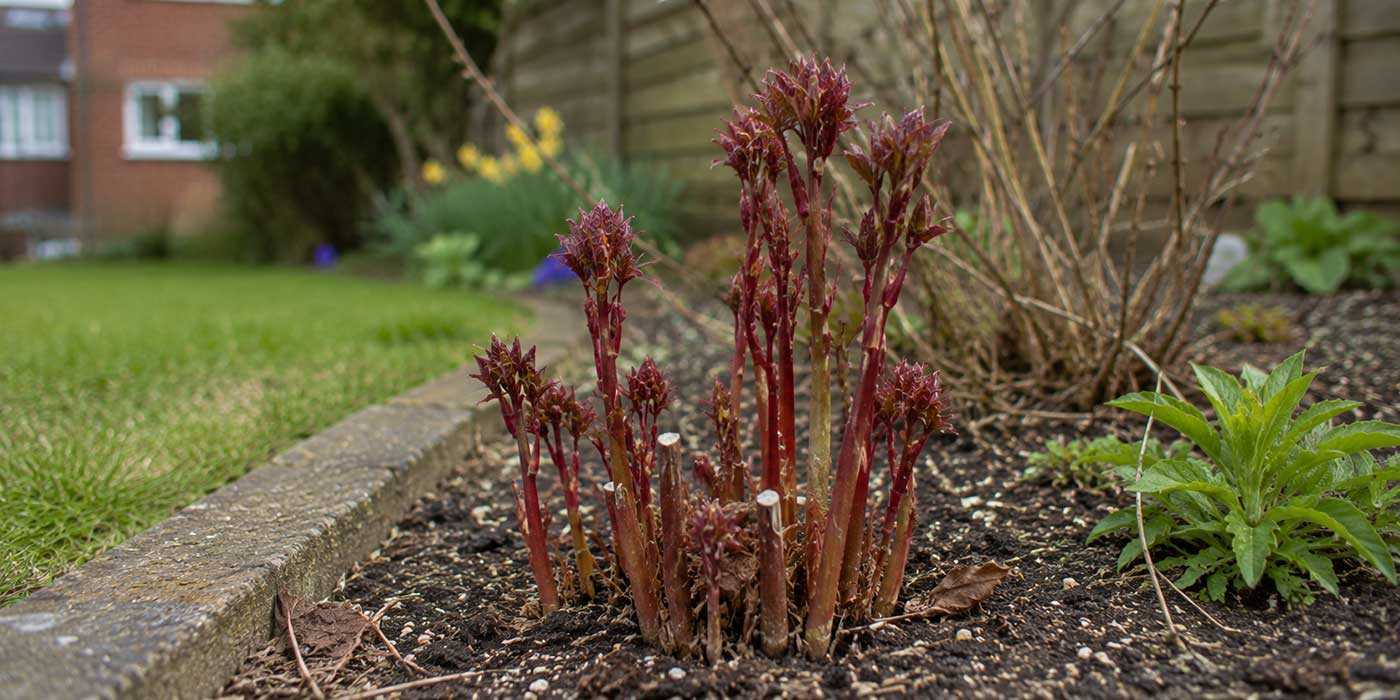
Peony shoots can also resemble knotweed
Peony shoots are another common source of concern.
During spring, peonies often emerge as thick reddish shoots pushing through the soil. The colour and early shape can look surprisingly similar to knotweed photographs online.
As the plant matures, the differences usually become clearer once peony foliage begins developing.
Dogwood and ornamental shrubs can produce red stems
Several ornamental shrubs create bright red spring growth that attracts attention.
Dogwood shoots, in particular, are sometimes confused with knotweed because of their colouring and rapid appearance after winter.
Unlike knotweed, however, these shrubs normally produce woody branching growth rather than hollow cane-like stems.
Bamboo shoots can cause confusion
Bamboo is frequently mistaken for Japanese knotweed throughout the year, including during spring.
Young bamboo shoots may emerge rapidly from the ground and can appear thick and reddish during early growth.
The mature plants also share a similar cane-like appearance, which adds further confusion for property owners comparing online photographs.
Location often influences concern
People become particularly worried when red shoots appear near:
- Paving slabs
- Boundary fencing
- Retaining walls
- Drains and inspection covers
- Garages and sheds
- Old building work
Because knotweed is often associated with these locations, suspicious spring growth nearby can quickly attract attention.
Growth pattern usually provides better clues than colour alone
The colour of spring shoots on its own rarely confirms whether a plant is Japanese knotweed.
The overall growth pattern is normally more useful.
Japanese knotweed commonly:
- Emerges in clusters
- Forms dense patches
- Produces upright cane-like stems
- Grows rapidly during warm weather
- Returns from the same area repeatedly
Single isolated shoots are often less suspicious than repeated clustered growth.
Spring photographs can sometimes be misleading
Many online knotweed photographs show very close-up images of red shoots.
This can unintentionally create confusion because several unrelated plants may appear similar when photographed from only one angle.
Whole-plant photographs showing the surrounding area are usually more helpful when comparing suspicious growth.
What usually helps identify suspicious red shoots
If you are trying to compare red shoots with Japanese knotweed, it often helps to photograph:
- The full area of growth
- Several shoots together
- The surrounding ground
- Nearby walls or paving
- Leaves beginning to unfold
- The height and density of growth
Natural daylight images normally provide the clearest comparison.
Many suspicious shoots turn out not to be knotweed
A large number of plants photographed during spring are eventually identified as ordinary garden growth rather than Japanese knotweed.
This is one reason why it usually helps to compare several features together rather than relying on colour alone.
Stem structure, leaf shape, growth pattern and location often provide a clearer overall picture than a single close-up photograph.
Related pages
Not certain what the plant is?
You can send a picture for an initial identification review.